Thursday, July 10, 2014


RITES OF PASSAGE

Yesterday I went to my local discount store for a short list of necessities. Necessities are likely to be augmented by an item or two that won’t break the budget but will please me in some way.
Such as: School Supplies!

It’s that time, folks—photocopied lists of supplies for each grade of public school—four short aisles, stuffed full, devoted exclusively to the needs (and desires) of shoppers who have elementary school children. Or, people like me.
Desert or Jungle?
A little impulse....
I was early, so no one could elbow me aside to get at the crayons (Camo Whammo! By Crayola), compass for drawing circles of any size up to a 12” diameter, or Fiskars blunt-tip scissors (with a safety sheath—and stickers!) in purple. To hold all these treasures, I found a small pencil box—plastic nowadays, alas (back in the day, they were cardboard, and we called them cigar boxes—because they were). Three-ring binders didn’t call my name, nor notebook paper, tabbed dividers, report folders. But my hand lingered over the Sketch Diary—such a pretty cover! And that lovely slightly rough paper ideal for pencil drawings. My fingers itched to create something on the empty pages. Very tempting. Then I remembered I already have several sketch books at home, various sizes, so I probably could wait for another year on that item.

What I did buy (besides the little items that fit neatly in the plastic box), were spiral notebooks—four of them, one-subject, 70 sheets each, roughly 9x12 inches. They’re ideal for making notes for my stories, writing scenes, or sometimes jut noodling ideas. And I bought one composition book (the kind we used in college a few decades ago) for my daily journal. I have a stash of these—different colored covers, or covers with different designs in black and white—but it’s always good to have an extra. You know, just in case.
What has any of this to do with Rites of Passage? I’m glad you asked. If your memory is still functioning, you’ll recall that once upon a time school supplies were strictly allocated per grade. In first grade—thick pencils about a half-inch in diameter, that filled a small fist trying to make the loops and slashes that turned into words; a very wide-ruled tablet for the little fist to practice those words; and an eraser, for the inevitable error.

Fast forward to fourth grade—talk about your rite of passage! We got to write (yes, cursively write) with fountain pens! And real ink! That was my first real intimation that I might, someday, be included in the adult world. Grownups wrote with ink and fountain pens. Teachers. Parents. The lady at the bank.
Much later, probably junior high (middle school to you younger folks), more freedoms were bestowed on us. We could actually choose our own three-ring binders, write all over the outside if we wanted to. Sadly, by the time I entered seventh or eighth grade, the ubiquitous ball point pen had come into being. I hung on to my fountain pens through several more decades; but eventually it became difficult to get quality ink and I retired my favorites to a drawer where I can visit them on occasion. And I still search for top-of-the-line ink for those precious pens.

Our grandchildren and great-grandchildren are experiencing rites of passage in the electronic age: second grade, iPads; fourth grade, tablets; sixth grade, laptops. All supplied by the school, with rental supplied by the parents. Inevitable, I suppose. After all, the world has become electronic in character. And my inner child sighs a little for the days of thick pencils and wide-lined tablets.
I still get a warm feeling, though, when I see little folks with big crayons in their fists coloring the placemats in restaurants. I wonder if any of them have Camo Whammo?


Thursday, July 3, 2014


We the PeopleCELEBRATING INDEPENDENCE

I’ve never lived in an oppressed nation. Wars for independence from a government that restricts freedoms from its citizens have passed me by. Citizenship was granted me when I was born in Charleston, Illinois, USA.

Because of where I was born and grew up, I had freedoms that came naturally—were taken for granted by me, as well as by most of the people I knew—such as:

·         Freedom to worship – when, where, and if I wanted to

·         Freedom to learn – school was compulsory until age 16, but learning can take place anywhere, with anyone, on any subject

·         Freedom to be – the person I became might not appeal to everyone, nor even to a majority, but it’s the person I was allowed to be, or claimed the right to be, and so it is who I am

·         Freedom to change – here’s the one I like best (well, sort of best) – change comes to everyone; it’s inherent in our very being: we are born helpless and dependent, we grow and learn to separate ourselves from others, we become the adult on whom others depend, then we grow old and dependent (perhaps) once more, and then we die. If anyone claims not to change at all—I’d like to see that person. Actually, I’d rather not, because a person who doesn’t change is probably dead.

·         Freedom to express my opinion, if I want to – guaranteed by the First Amendment to the Bill of Rights of the United States of America. And we’ve all read or heard of instances where someone’s opinion was dangerous and caused untold misery; where claiming protection under the right to freedom of speech was used to ill purposes. But I, and you, all of us, have the right to express ourselves – with the caveat that we don’t hurt anyone else. Perhaps our forefathers assumed we’d know that, common sense being in greater supply back in the day.
These Freedoms are what today give us – all of us – the independence so many fought and died for in the 1700s, and continue to fight for in the 2000s. It doesn’t have to be a bloody battlefield fight; it can be as close as your local food bank – the free summer lunch program for school-age children – the rescue mission for men and women who have bottomed out and yet find a place where someone loves them and wants to help them come back from addiction, abuse, and a sense of futility and worthlessness. It can be in your own family – a child who needs a helping hand, a grandchild whose employment ends and who needs a place to live, a spouse who suffers from depression or a medical problem and who needs acceptance and the knowledge that someone cares enough to stand by them.

Independence isn’t just some high-flown, abstract concept – Independence is a sense of self-worth, which leads to a sense of being connected to others – and ultimately, Independence is trumped by our dependence on a divine being (whoever we acknowledge that to be).
Thank you for allowing me to express my opinion. Yours may be different, based on your experiences. But you still have Freedoms. Guaranteed. Give thanks for them. And--don’t forget them.


Thursday, June 26, 2014

CELEBRATING THE DOWN-SIDE

Last week I participated in a blog tour--a virtual visiting on other folks' websites. Some of you may have read my post.

In my comments, I mentioned that I was entering a writing contest. It was in three stages: Stage 1 - submit the first page of the manuscript. Stage 2 - if the first page was sufficiently intriguing, then the writer would be asked to submit the first three chapters. Stage 3 - if the first 3 chapters showed promise, then the whole manuscript would be requested.

My first page didn't earn me a pass to Stage 2, so that was the end of the contest for me. But I didn't lose heart. True, it wasn't what they wanted; however, they didn't send me a nasty rejection email, just a simple statement that it wasn't what they were looking for and if I had another manuscript I'd like to submit to that line, I could do so in the regular way, through their website.

In a strange way, not getting to Stage 2 was a relief. I'm still writing the story whose first page I submitted. I have four fleshed-out chapters that I like so far. And I intend to finish the book.

What I learned was this: not advancing in the contest was okay. It might be considered the down-side of contest entries; but in another way, it allowed me to participate, learn that what I like to write isn't going to fly with that publisher's line, and now I'm free to write what I believe is the story I'm supposed to tell.

Some Life Lessons aren't easy or pleasant to learn. This one was much more positive.

-----
Another Plus: Having a story to work on does wonders for my summer blahs. While I'm writing about characters dealing with their problems and wondering if they're doing the right thing, I'm off in some kind of other-world. Today's humidity, thunderstorms, and wind don't enter into it. I sometimes finish a chapter, get up and walk around, and am surprised to find the air has cleared, the sun is out, and people who live in my neighborhood are home from work.

Could this down-side business be another way of looking for hidden blessings? I like to think so.


Thursday, June 19, 2014

GRACE NOTE
 
[Grace Note: a musical note added as an ornament.]

Did you ever have a sudden wash of well-bring come over you?

It happened to me, a few minutes before six one evening, as I was finishing my meal. I had eaten a combination of quinoa and rice, topped with steamed broccoli, and cooked chicken breast, seasoned with ground pepper and garlic powder; and to finish, a slice of fresh Indiana cantaloupe, peeled and lightly salted. Before the coffee had finished brewing, my spirits lifted.


Was it the alchemy of the foods? I often eat the same or similar combinations, winter and summer, spring or fall.

Was it the smell of the coffee as it brewed? Half decaf House Blend, half regular Pike Place, both from Starbucks. After the brewing, it is poured into a tall mug in which creamer has been heated.

Or was it the book I was reading—a multi-reread of W. J. Burley’s Wycliffe and the Dunes Mystery. I get no particular jolt in these rereads; they’re solely for the purpose of visiting with folks I know and admire, like the visits I make to my friend Jane’s house, or lunch with Liz a few times a year.

None of these possibilities strikes me as the reason for what I think of as sudden happiness. Each is good in itself; they are good together; but even the combination of all the elements doesn’t add up to a welling-forth of quiet ecstasy.


Mystery, yes. But possibly, more than likely, a divine gift.

And so I say, Thank You.


Thursday, June 12, 2014


CALENDARS, PLANNERS, AND LISTS, O MY!

Remember the puzzles in Highlights for Children: “What do these three things have in common?”
Besides the fact that I’m addicted to all three, they are all time management devices.

I learned about calendars when I was in elementary school. You probably recall the old rhyme…

                Thirty days hath September,
                April, June, and November,

                All the rest have thirty-one,
                ‘cepting February alone.

                It has twenty-eight in fine,
                ‘til leap year gives it twenty-nine.

After learning that rhyme, every month makes sense. Not logic, but sense.
True, they don’t all have the same number of days. Which means they don’t have the same number of weeks.

The days of the week change from month to month—change their numbers, that is.
But never mind the logic--most of all, calendars are ways we mark the passage of time—arrival and departure of seasons—special days, such as national holidays, or birthdays, or anniversaries of one kind or another—appointments we mustn’t miss—reminders to give the dog a pill or fertilize the lawn or get the car in for service.

They’re time keepers for all of us, if we use them.
And sometimes their pictures are downright gorgeous!

-----

About fifteen years ago I was introduced to the planner—now a ubiquitous part of many lives. My young friends assure me that their elementary school age children have planners. These are accompanied by agendas. Goals are set. Results are recorded. Progress tracked.

My own planner, now a shadow of its former self when I worked a regular 40-hour week, still helps me keep track of my days. There’s simply too much to put down on a calendar. A planner page, even divided into 4 sections, as I do, can list all the things I need to do or remember Today. And if something doesn’t get done Today, why, it can just pop over into the next section to be considered Tomorrow.

-----

But my favorite, favorite method of keeping track—of anything—is The List. I call it The Today List, because what’s on it is for Today. If—as above with the planner—one item doesn’t get done, it goes on the next day’s Today List.
My Today List is usually written on a 3x5 card that pops into my purse when I go to the store or run errands. When I get back from my running around town, I take it out of my purse and leave it on the dining room table where I sit to work at my laptop, eat meals, drink coffee, read…the ideal central place for my life. My cell phone lives there also.

Of course there's a disadvantage--lists have a way of growing in the dark, like mushrooms.

-----

I had thought retirement would bring me more freedom. I wouldn’t have to keep track of so many things, because everything didn’t have to be done after work hours.
This was one of the biggest boo-boos I’ve ever made. Freedom? My current calendar/planner/lists reflect the usual things—doctor and dentist appointments, birthday reminders, and so on. But retirement didn’t mean I had nothing to do. As most retirees find, activities expand to fill the time.

The former 40 hours spent in an office are now open for deeper cleaning, sewing and knitting, writing; reading; writing snail mail letters and notes instead of emails. I can spend a whole day at my daughter’s house canning her garden produce. I can investigate new stores or old ones I’ve never been to. My quilting friend and I go on road trips to quilt fabric shops within an hour of our homes. And those can be any day of the week we are free. Two mornings are set aside for exercise classes.

What did bring me more freedom is having a planner and a Today List to go along with the calendar. If I’ve been faithful in keeping all three tools up to date, then I find my days are less stressful. No forgotten appointments, no sudden memory of birthdays this week.

And believe me—reducing stress certainly feels like freedom. I’m a slave only to whatever list I’m currently following. And even I can manage to lose one from time to time.

Have a lovely stress-free day. Hide the planner, lose the list…the calendar is just a pretty picture!

Monday, June 9, 2014

WRITING Q&A

Good friend and writing buddy Liz Flaherty did a virtual arm twist to get me to join her blog tour. If you haven’t met her, here’s a little about her and her writing:
Life is new and wonderful for writer Liz Flaherty these days. She retired from the post office in 2011, promptly gained 15 pounds—she swears it was overnight—and promised her grandchildren, The Magnificent Seven, that she would make each of them a bed-size quilt. She also planned to write all day, every day. What was she thinking?

She’s learned to write when she feels like it, sew when she feels like it, and maybe even to eat a little less. She’s learned to share the house and sometimes even the kitchen with Duane, her husband of, oh, lots of years. And she’s having a Very, Very Good Time.
Her eighth book, THE GIRLS OF TONSIL LAKE, has been released to exciting reviews by The Wild Rose Press. She is thrilled to the point everyone she knows rolls their eyes as soon as she opens her mouth. JAR OF DREAMS came out in January, followed shortly by her first inspirational romance—A SOFT PLACE TO FALL released by Harbourlight books—and she hasn’t annoyed hardly anyone about that yet.

Visit Liz at http://lizflaherty.com  or email her at lizkflaherty@gmail.com—she’d love to hear from you and the coffeepot’s always on!
-----
So that’s how I got hooked up with this blog tour. Each writer is asked to answer four questions, so here goes.

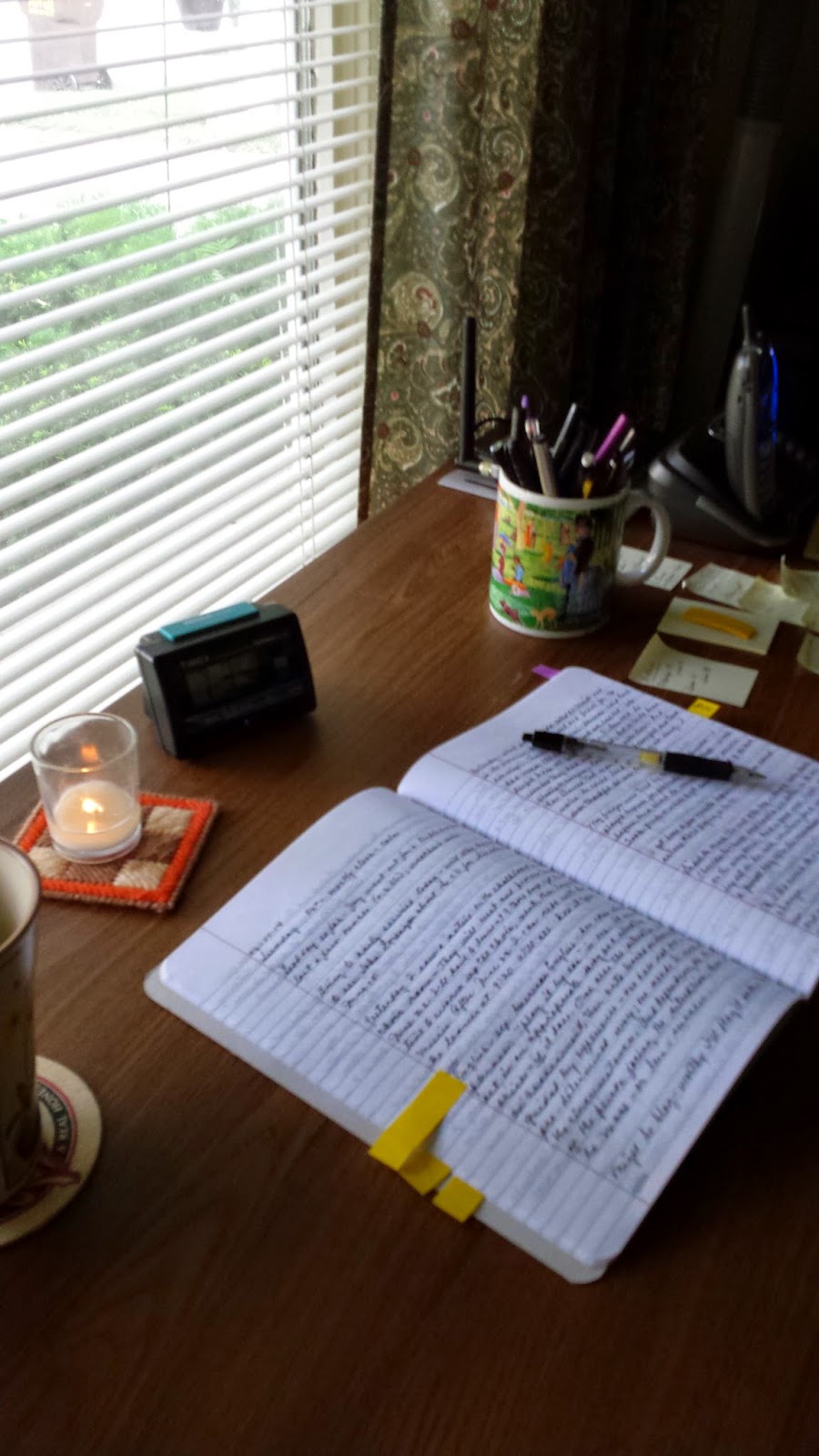
Journal, etc. for AM writing
1)            What am I working on?
I write a weekly blog, so ideas come along any day, any time. That’s an ongoing project. In the realm of fiction, currently I’m working on a novel for the Christian market. And I’m entering a writing contest!

2)            How does my work differ from others of its genre?
This is a hard one to answer. Not sure my work does differ. But follow me ramble as I ramble on. My blog ranges over a wide area—not only writing; I explore sewing, quilting, music (I’m an organist), knitting, cooking—plus anything else that happens to grab my attention, like bird watching and growing flowers. Under the Writing tab: Prior to the current novel project I finished nine novels and have a WIP two-thirds finished. There are three or four future novels in note-form, waiting for their turn in the computer. These 10 + 3 or 4 are women’s fiction—closer to the former mid-list stories (remember those?). As a college prof of mine once called them, “just a rattlin’ good story.” I hope my stories are unique, but also universal. (If you figure that out, you might drop me a line and explain it. I think I know, but . . . .)

3)            Why do I write what I do?
I don’t know how to do anything else; that is, I’ve always written about my life: in essays, journals, and stories. Fiction is a safe way to work through bad memories; in essays I test ideas and engage with folks who like to read about what I experience and what I think.

4)            How does my writing process work?
Bear with me here: I’ve never analyzed how my writing process works. Taking the question literally, I have to admit, sometimes my writing process doesn’t work at all. Some days/weeks/months I write nothing of any length. Because? I’ve discovered there are times when applying strict discipline accomplishes no forward movement. But that's just me. Other folks report good results with applying derriere to chair, whether the ideas show up or not.

What I do is this: I journal early every morning, right after I come back from my morning walk. My journal is a repository for whatever floats through my consciousness. As I write, I go deeper into whatever is in my mind. Sometimes I brainstorm about blog ideas; other times, it’s working out a character for a novel; more rarely, I have to dump whatever is holding me back—anger, sorrow, fear—the residue from a recent event. Or, I write about something that is just a condition of life. Or human nature.
That’s pretty much me as a writer. Hope you’ll come back and visit—Thursday’s Child pops up every Thursday—here’s the link: http://www.jrjerints-palmer.blogspot.com.

Thanks for stopping by for a visit. And thanks to Liz Flaherty for twisting my arm. Don’t forget to visit Liz’s blog, and check out her books on Amazon and Barnes & Noble.
‘Till next time…..

Thursday, June 5, 2014


ISSUES

Some time ago—I think it was while I had my afternoon nap—the word issue came into its own.
I lay down to rest my eyes and mind, determined not to think about any more problems for the next 45 minutes—and I woke up to discover my problems had received an upgrade. Now they were . . . Issues.

Everywhere I turn, there they are: health issues, banking issues, car issues (really??), personal issues. The danged things are fertile as guinea pigs.
I can’t open a new can of dog food without having issues with the pull-tab lid. My phones are having issues of their own (probably in-fighting among relatives).

AHEM........!
The dog reports issues—not enough food, wrong kind of food, water dish empty, and the biggest issue of all: I’m not reading her mind about when it’s time to go out and . . . you know. (This last issue has resulted in carpets that desperately need cleaning, my own fault, of course.)
After a good long think about the I-word, I’ve concluded that it was born as a replacement for the P-word.

Consider this:
·         Problems generate the companion word solutions
·         Issues, however, are stand-alones; they just are; they require no action, they merely exist; of course, you’re free to “deal with” issues; they won’t mind. But you’re not obliged to do any deep digging for a solution.
·         If I name something an issue, I have given it new status; I’ve made it into a virtual statue in the park: look, touch, talk about—but you don’t have to do anything with it.

The main issue with issue is the way it gathers moss as it rolls along. For decades we’ve had morticians (who used to be undertakers); water pollution control departments (formerly water and sewer departments); refuse removal (garbage collection); marketing associates (sales people); and a whole boatload of other definitions to sanitize what used to be just Life As It Is.
Some changes, I know, are plain common sense: Letter carrier instead of mailman—after all, many postal employees who deliver mail are women.

Now, before anyone gets the wrong end of the stick and runs off with it, let me say this: I’m all for changes in language. That’s a sign that a language is living. For instance, we no longer say, “Thou art more to me than yon mountain or sea.”
The real, um, well, issue here is this—are we communicating? Do we truly understand one another? Am I, by the words I choose, giving you a false impression of what I believe? Or feel? Or know?

Sorry to run . . . you’ll have to excuse me now—my neighbor boy is coming today for tutoring and I’m going to have to do a little study. We’re going to work on his math--story issues, I believe.

THURSDAY’S CHILD will publish Monday, June 9, as part of a writers’ blog tour. I’ll talk about my creative writing endeavors, and introduce you to Liz Flaherty in more depth. Come join us as we talk about our writing projects and habits.

No issues here, boss.