Due to an intermittent router, today's post on Thursday's Child will not be seen.
Check back in a few days, after I've been to the AT&T store.
Thanks!
Thursday, April 17, 2014

Thursday, April 10, 2014
SPRING TONIC
In my grandmother’s day a good dose of blackstrap molasses
and sulphur cleaned out the human system, warded off any lingering malaise from
winter’s icy clutches, and tuned up the body for three seasons of hard work on
the farm.
In my youth, the Spring Tonic on Grandma’s shelf was
replaced by a few cups of Sassafras tea or stewed rhubarb, which pretty much
worked the same way as the dreaded tonic. By the time I became a grandmother, a
week in Cancun or Barbados
or Aruba was the remedy. Or if your pocketbook
resembled mine, five days in Kalamazoo
Some of my friends—whose pocketbooks may be anorectic—swear
by a day at the spa.
Say “spa day” and right away you’ll conjure up a jumble of
images—pummeling and pomading through ten hours of sauna, massage, styling,
tweaking, manicure, pedicure, every-kind-of-cure for the common blahs and
disenchantments of the face and figure. Wintertime, springtime, anytime.
 |
| View of one of the "Chain" |
We drove from Auburn, my friend Janine and I, in her 4X4, to
Chain-O-Lakes State Park about 30 minutes away. Picture a day in late April.
Spring sunshine, leaves taking their time unfurling their shades of green.
Water standing in fallow fields, running in ditches, swelling creeks, all from
late winter snow that had no chance against a young spring breeze and honest-to-goodness
sunshine.
In northeastern Indiana we celebrate the first day of spring
with the rest of the civilized world—around March 21st when the
spring equinox shows up on the calendar. We know that’s a token celebration—on
a par with a green Christmas—because real
spring, the one worth celebrating, comes on a day when you least expect it.
It’s a mid-week day, when offices and schools and businesses are up and
running, expecting their employees and clients and students and customers to
show up as well.
But.
On a real spring
day, some of us are privileged to get in a 4X4 and cruise the trails and roads
of a state park. 10 mph cruising. No hurry. No agenda. Only the journey.
The 4-by heads into the park, makes a loop around one or two
of the lakes in the chain, from which the park gets its name, and climbs one of
the steep hills into a wooded area. Campground, cabins, fish-cleaning station….
Down another hill into the valley floor. What used to be a racing creek has
expanded into a flowing meadow. The water’s nearly level with the bridge over the
no-longer-dashing waterway.
We stop and park on the side of the road. Janine takes out
one of her cameras, a monster thing with a long lens that allows her to poke
her eye into Nature’s intimate business from a safe distance. I watch last
autumn’s leaves float down the lazy stream and let the sun fall on my face.
Our only companions are woodsy inhabitants, too shy to come
out.
 When Janine winds up her photo op, we continue our loop
around the park, and end up at one side of the biggest lake where a pier juts
out into the main channel. I stand in the sun, my arms propped on the side supports
of the pier, while Janine snaps photos of me in various hats and scarves for
future use as publicity pics.
When Janine winds up her photo op, we continue our loop
around the park, and end up at one side of the biggest lake where a pier juts
out into the main channel. I stand in the sun, my arms propped on the side supports
of the pier, while Janine snaps photos of me in various hats and scarves for
future use as publicity pics.
We’ve spoken fewer than fifty words since we entered the
park. No pummeling, no pomading. No need for the delights of the day spa.
Because here, in this natural setting, we’ve bathed in warm
spring air so delicious you can almost taste it, spied out elusive greens that
will soon be in full leaf to delight the eye, caught the springtime perfume of
sun on old leaves and new growth. Our souls have basked in Nature music: bird song,
trickles of water running over stones, dry leaves from a year ago whisked away
by a sudden breeze.
We’ve spent no money. Yet we’ve received simple gifts: cures
for the common winter blahs, and disenchantments of the spirit. You can’t
bottle this tonic and sell it for profit. This cure is free for the taking. If
you want it.
 |
| Autumn @ Chain-O-Lakes Another inspiring season |
Thursday, April 3, 2014

 TEACHING & LEARNING
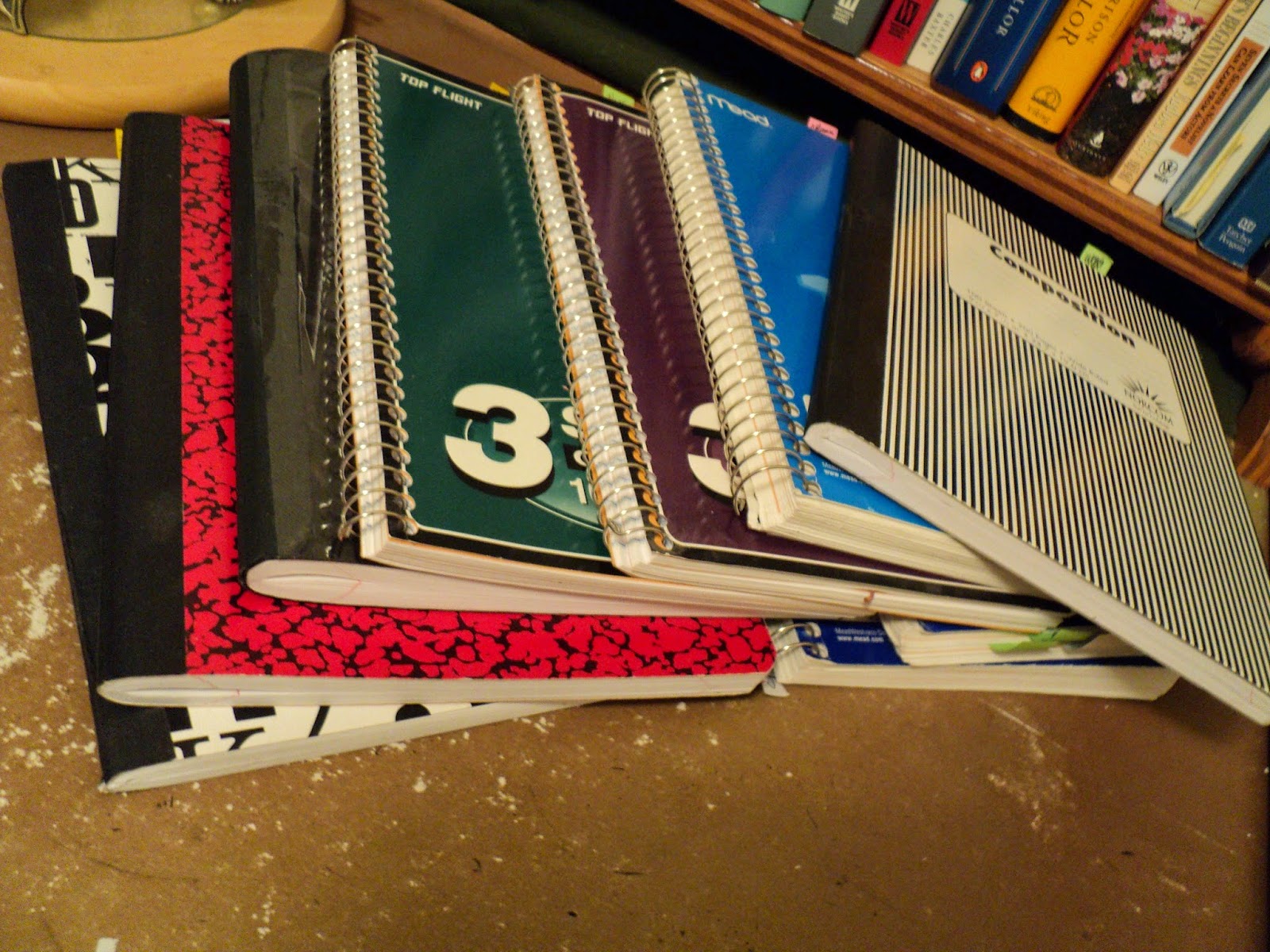
In September, 2000 I began journaling daily. September is the start of my personal year--a holdover, probably, from when I was a perpetual student, loved school, and summers were just annoying periods of being hot and unhappy until fall approached and school doors opened once again.
Anyway. That's beside the point, sort of.
My journals are dumping grounds for information, quilting diagrams, emotions, you-name-it. Journals have also become a wonderful way for me to explore ideas.
Take yesterday--I never know where the nudge comes from, but I often find myself writing about something I might want to blog about one day. That morning's nudge was about lessons I've learned--how we learn from each other--about being a teacher, or an example, to other people.
Lessons come from everywhere: friends, family; strangers; neighbors; my dog. . . . Here are some random thoughts from my writings:

- I learn about unconditional love and forgiveness from Joy, my dog. If you've ever owned--or been owned by--a dog, you'll recognize their seemingly infinite capacity for love and devotion. They forgive your bad moods, your ranting about something totally unrelated to them, your forgetting to fill their water bowl or feed them on time. I find that love and forgiving nature quite humbling.
- I learn that time and distance mean nothing with true friends. One friend of over 40 years' standing is as present when she comes to visit three times a year as she was when we spent hours together every single day during our college years. We seldom write letters or emails or talk on the phone. We don't need to, because we are so in tune with each other.
- I've learned about friendship among people with radically different beliefs--there's always some point of contact, some connection that allows us to know we're friends.
- Another lesson has shown me that young people the ages of my grandchildren can be my friends--it's a matter of finding similar interests and respecting our differences; and then being present with each other. Caring is another word for it.
- I constantly learn from my children: about their worlds/careers/interests. They share their beliefs (which are not always the same as mine), knowing that our mutual love and respect mean that we can discuss a wide range of topics without animosity.
- I learn that caring for others is alive and well in my neighborhood--we have only a few young families, with school-age children; most of us are 60+, retired, and in various stages of our lives. Yet there's a little network of checking in with each other, looking for signs that someone needs help, taking food to share with a shut-in down the street. The younger folks get into the act, helping rake leaves in the fall or shovel snow.
-----
Teaching and learning are wonderfully symbiotic--teaching someone a skill leads to the teacher learning something as well. And a pupil learning something new becomes, unwittingly, perhaps, a new disseminator of that same bit of knowledge.
A number of years ago I taught freshman composition at Purdue University. Every semester I learned something I hadn't known before. Most of my learnings were about people. With each new group, the chemistry changed. Classes were composed of varying ages: high school graduates, returning students who had left for some reason, or adults recognizing a need or desire to get a degree. My favorite classes were the ones with students ages 18 to 40 (or older). With no planning on my part, I often witnessed the older students teaching the younger.
One year we had an assignment to read about a Christmas celebration. In class, we discussed the reading and told about our own experiences. A quiet woman in her 50s startled the rest of the students by saying, "Christmas Eve is the loneliest time of the year."
I've never heard a classroom grow so quiet so suddenly. The woman went on to say that she had no family, and all her friends went to their families for Christmas.
Clearly, younger students had never experienced such a thing. They were stunned. I suspect a few did understand because their Christmases weren't happy ones. But the majority were hearing about a lonely Christmas for the first time.
That experience happened over 30 years ago. It still lives for me as one of the finest examples of learning from each other, in an informal way.
-----

Book learning has always been important to me. I don't know what I'd do without books.
But the best lessons--the ones that stick with me longest--are the ones I learn from people.

There's no substitute for family . . . our earliest lessons come from the folks who welcomed us into the group, nurtured us, disciplined us, and eventually shoved us out of the nest.
Today I celebrate teaching and learning. I celebrate the teacher in all of us, and the lessons we've learned--quickly, painlessly; or the tough ones that make, perhaps, a bigger impact.
Keep on learning. And teaching.
Thursday, March 27, 2014
DEBUNKING A MYTH
I love debunking myths! What fun to shoot down a bit of "accepted wisdom" that started as somebody's opinion and has little evidence to hold it up.
The myth I'm taking on today is this: "Eating gluten-free is too expensive!"
Here are some facts:
Then--next step--learn how to bake your own GF foods.
One of my favorite websites is Gluten Free on a Shoestring, hosted by Nicole Hunn. She gives exactly what the title promises--eating gluten-free on the cheap.

And--she has three cookbooks out:
Her secret? The "shoestring" part comes from--ready for this?--starting from scratch.
Remember cooking from scratch? It's what we all used to do before we could buy convenience foods, prepared foods, boxed dinners, and deli meals.
I can't say enough good things about Nicole Hunn's website, her recipes, and her books. She knows where to buy certain hard-to-find ingredients, but she also knows we can't all get them. So she tells us how to cook without those items.
Nothing is exotic. This is all good food, some of it comfort food a new GF diner might miss.
Check out her books and spend a little time in the kitchen. You'll be glad you did.
(In case you're wondering, Nicole didn't pay me anything for this plug.)
-----
The main reason folks need to change to eating gluten-free is health. So the question becomes: Is improving your health too expensive?
We spend beaucoup bucks on vitamins, supplements, and various products that are supposed to do something wonderful for your well-being. If I can spend a little more on certain foods--and at the same time quit taking some of the items drilling a hole in my change purse--I'm willing to try.
Maybe that's because I like cooking and trying new recipes.
 One thing you won't have to buy, if you decide to cook from scratch, is all new equipment. Look in your cupboard--if you have mixing bowls, measuring cups and spoons, wooden (or not) spoons, and spatulas, you can make nearly everything you need. A mixer is handy but not required. (Mine is 30+ years old and still does its thing with panache. And it's a little hand-held job.)
So what have you got to lose? Some time spent reading a new cookbook and experimenting in the kitchen; some time at the grocery store searching for those elusive GF ingredients (hint: They're often in a special section, sometimes called Natural Foods). You may garner some gripes and grunts and grimaces when your family and friends sample the results. But you may--and this is the cream--get a few comments that make it all worth your while. "What did you say this was? Gluten-free? What's that?" Or (my favorite), "If you hadn't told me, I'd never have known it was gluten-free."
-----
Next time you hear the phrase gluten-free, don't sneer. Keep an open mind. Learn a little more about it. And if you never have to change your diet to gluten-free, recommend websites and books to folks who do. It's all about health--and feeling better. I'm all about that!
I love debunking myths! What fun to shoot down a bit of "accepted wisdom" that started as somebody's opinion and has little evidence to hold it up.
The myth I'm taking on today is this: "Eating gluten-free is too expensive!"
Here are some facts:
- Prepared gluten-free products can be expensive.
- BUT, a great many products are gluten-free naturally--fresh produce, fresh meat, fresh fish/seafood, spices and herbs.
- Some canned and prepared items are gluten-free--they say so on the label. (Read your labels.)
- More and more restaurants are offering a gluten-free menu--even one of our Italian eateries has GF pasta!
Then--next step--learn how to bake your own GF foods.
One of my favorite websites is Gluten Free on a Shoestring, hosted by Nicole Hunn. She gives exactly what the title promises--eating gluten-free on the cheap.
And--she has three cookbooks out:
- Gluten-Free on a Shoestring
- Gluten-Free on a Shoestring: Quick & Easy
- Gluten-Free on a Shoestring Bakes Bread
Her secret? The "shoestring" part comes from--ready for this?--starting from scratch.
Remember cooking from scratch? It's what we all used to do before we could buy convenience foods, prepared foods, boxed dinners, and deli meals.
I can't say enough good things about Nicole Hunn's website, her recipes, and her books. She knows where to buy certain hard-to-find ingredients, but she also knows we can't all get them. So she tells us how to cook without those items.
Nothing is exotic. This is all good food, some of it comfort food a new GF diner might miss.
Check out her books and spend a little time in the kitchen. You'll be glad you did.
(In case you're wondering, Nicole didn't pay me anything for this plug.)
-----
The main reason folks need to change to eating gluten-free is health. So the question becomes: Is improving your health too expensive?
We spend beaucoup bucks on vitamins, supplements, and various products that are supposed to do something wonderful for your well-being. If I can spend a little more on certain foods--and at the same time quit taking some of the items drilling a hole in my change purse--I'm willing to try.
Maybe that's because I like cooking and trying new recipes.
One thing you won't have to buy, if you decide to cook from scratch, is all new equipment. Look in your cupboard--if you have mixing bowls, measuring cups and spoons, wooden (or not) spoons, and spatulas, you can make nearly everything you need. A mixer is handy but not required. (Mine is 30+ years old and still does its thing with panache. And it's a little hand-held job.)So what have you got to lose? Some time spent reading a new cookbook and experimenting in the kitchen; some time at the grocery store searching for those elusive GF ingredients (hint: They're often in a special section, sometimes called Natural Foods). You may garner some gripes and grunts and grimaces when your family and friends sample the results. But you may--and this is the cream--get a few comments that make it all worth your while. "What did you say this was? Gluten-free? What's that?" Or (my favorite), "If you hadn't told me, I'd never have known it was gluten-free."
-----
Next time you hear the phrase gluten-free, don't sneer. Keep an open mind. Learn a little more about it. And if you never have to change your diet to gluten-free, recommend websites and books to folks who do. It's all about health--and feeling better. I'm all about that!
Thursday, March 20, 2014
 |
| Pillow my daughter made for me years ago...great sign! |
"Sign, sign, everywhere a sign!"
That was part of the refrain of a protest song of the 1970s, "Signs."
Today I'm not protesting the arrival of the Vernal Equinox, which is 'way too formal for the season we welcome as Spring!
But there are certainly signs . . . everywhere you look.
 |
| Daffodils pushing through leaves |
For several days I've noticed more birds in our neighborhood. They're singing, chattering, calling . . . each according to its nature. Of course we've had birds all winter long--bluejays, cardinals, robins (who do not migrate south in winter, something I never knew until a few years ago), and the smaller birds, some of whom are rather timid except when the feeders are full and yummy seeds fall while other birds feed. Until the recent dawn choruses, I hadn't realized how much I missed birdsong. I recognize only a few. I've never kept a life list of birds observed. But they are such a part of my daily scene that when they're gone, it's obvious something is missing. Their music completes the story.
Blatant signs include the disappearance of snow banks, some of them seeming to go down by inches as we watch. Underneath--grass! Truly! Grass--green, brown, muddied up by snowplows and snow throwers--but grass, nevertheless. The grassy areas expand daily, and Joy and I can now walk around the house with only one or two places where we must cross snow to get to the snow-less patches.
Joy's big thrill is being able to sniff out whatever it is that tickles her fancy, and has been covered up for so long. Some days I get almost nothing done because she wants to go out--again!--after all, the sun is out, and there's grass out there to be explored. She knows I don't understand, and she's very tolerant of my ignorance. But she is insistent.
 |
| Surprise Lilies coming up |
Although Spring is not my favorite season, I'm always more than ready for its return. More than any other season, Spring seems to remind us that our world is indeed orderly. We may not get the season we want on a certain day, but it will come. And its companions will follow in their own time.
 |
| Haven't seen this much ground since before December! |
Amazing to me, the absolute determination of those bulbs to push through the ground; tree buds to appear on branches; grass to grow in spite of snow, rain, sleet.
All those signs make me realize: More than hope appears with the return of Spring--I call it affirmation. Affirmation of new life--animals, birds, plants--reminding us that in spite of our selves, the earth renews and we are the beneficiaries of that abundance and beauty.
Thursday, March 13, 2014
HIDDEN
GIFTS
In a recent post I may have promised no more winter blahs,
gripes, or rants.
Too bad, if I did, because I want to re-open the
subject—not, I hasten to say, to blast away at winter’s grip on the upper
Midwest—but to share some insights that came about one day when I wrote in my
journal about winter. I was feeling particularly upbeat that day, and decided to
explore the subject of redeeming social value to winter.
Now you have to understand: I am not an athlete, I do not
ski or ice skate, or go on long winter treks through woods. I like winter
landscapes, so long as I can admire them from a warm house, with a mug of hot
chocolate or fragrant tea in hand; and if the house is drafty, I’ll wear a
couple layers of turtlenecks and heavy knitted sweaters. When folks say they
hate winter because it’s so ugly, I shake my head. The shapes of trees and
shrubs are visible without their leaves. Winter shadows are blue on snow.
Evergreens are greener against a background of less color.
With that background, I’ll tell you some characteristics I
discovered about winter that deserve recognition. I call them Hidden Gifts.
If you look outside and all you see is snow cover, then you
could say everything is hidden by the snow. Grass, shrubs, mulched flower beds,
patio, sidewalk, driveway. I know they exist under their white cover.
But the Hidden Gifts I’m thinking about are the benefits
(really!) that accrue because of deep
snow and cold.
Here are some thoughts to share with you:
 |
| Spring - dinner time |
·
Monday and Tuesday this week were milder, temps
warmer, snow melting and running down the drains; everyone I spoke with smiled,
talked of spring days to come. In the midst of snow piles on every corner,
higher than our heads, and a forecast of 4-8 inches of new snow yesterday,
those mild days were a gift. Not exactly hidden, but it’s easy to forget how
nice those days were when the new snow clogs up driveways and streets, closes
schools, and causes us to cancel medical appointments and scramble to
reschedule. The soft days were a gift we didn’t anticipate and roused our
hearts with hope for spring.
 |
| Summer feeders |
·
A truly hidden gift is the benefit of snowmelt
on our water table. We may wonder where all that snow is going to go, but
eventually it does melt and much of it goes underground. We are guaranteed
future moisture for our crops, lawns, and trees. Two years ago in our area of
northeastern Indiana, the summer was one long drought. We watered, we mulched,
we prayed…and we watched our annuals droop, our perennials wither, and worried
about the trees that sheltered us with their leaves. This year’s crop of water
ought to meet the needs of whatever summer brings in 2014.
·
Then those sharp days, with below-zero temps
that seemed never-ending, all helped wipe out pests that live from year to year
when we have mild winters. Our crops, lawns, and landscaping won’t be
compromised so much in the seasons to come. Not to mention relief for allergy
sufferers with respiratory problems.
 |
| Same feeders - winter |
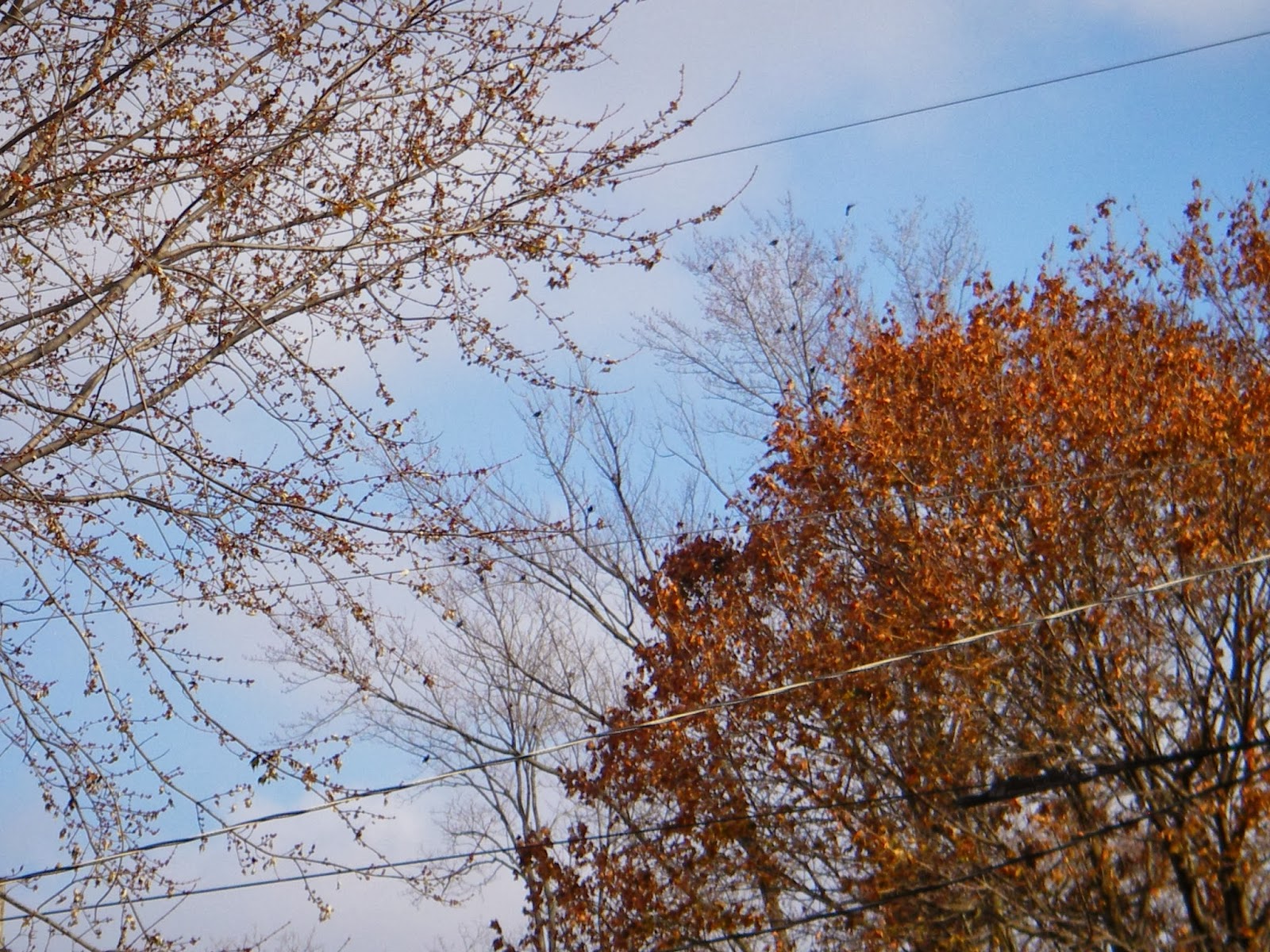 |
| I'd hate to miss this sight. |
Years ago I dreamed of spending winters in southern Arizona.
Eventually the dream expanded to include retirement. Now—I’m a little more
realistic. The warmer climate would be wonderful for a winter or two, but I
know I’d miss the four seasons we enjoy here in the Midwest—southern Arizona
has seasons, but the changes are more subtle. I’m all for the ones that have
definite personalities.
Maybe I can expand this exercise about finding hidden gifts in difficult or unwanted circumstances to the rest of my life. Not
every cloud has a silver lining, but I won’t know until I look for one. It just
might be there.
 |
| Autumn 2013 - leaves in my back yard. |
Thursday, March 6, 2014
HERE COMES YOU-KNOW-WHAT
 After my rest
I’m up at 4 PM (not 3)—time for a cup of tea and I’m rarin’ to go again. Not
because I got a second wind, but because the evening light is going to last and
last and last. Light is obviously a big factor in my alertness and well-being.
After my rest
I’m up at 4 PM (not 3)—time for a cup of tea and I’m rarin’ to go again. Not
because I got a second wind, but because the evening light is going to last and
last and last. Light is obviously a big factor in my alertness and well-being.
Or maybe you don't . . .Daylight Savings Time arrives this coming Sunday, March 9,
at 2 AM. I will not be up to welcome it. I am never up at 2 AM, unless insomnia
has hit.
One good thing: I don't have to "spring forward" on the clock before I go to bed. I have three timepieces that do it for me: an atomic clock; my computer; and my cell phone. I can, the next day, at my leisure, advance the hands or digits on the electric range, microwave, car, my watch, and two small battery-operated alarms I use from time to time. We--my dog and I--have a time keeper in every room, just in case we need to know what hour it is. (Joy, as you might have guessed, doesn't care about numbers; she knows mealtime, going out time, treat time, and bedtime. Much simpler. She doesn't have much use for DST either.)
One good thing: I don't have to "spring forward" on the clock before I go to bed. I have three timepieces that do it for me: an atomic clock; my computer; and my cell phone. I can, the next day, at my leisure, advance the hands or digits on the electric range, microwave, car, my watch, and two small battery-operated alarms I use from time to time. We--my dog and I--have a time keeper in every room, just in case we need to know what hour it is. (Joy, as you might have guessed, doesn't care about numbers; she knows mealtime, going out time, treat time, and bedtime. Much simpler. She doesn't have much use for DST either.)
 |
| The only 2 o'clock I know is PM. |
But the main reason I never welcome Daylight Savings Time is that I don’t like
it. My early morning walks out of doors, starting at 6:00, are postponed until
mid-May when the sky is light enough to show upheaved sidewalks, downed
branches from the previous day’s storm, and abandoned tricycles/golf
clubs/tennis shoes/fast-food wrappers/umbrellas. (Before you ask, no, I do not
live in a major city with striking garbage collectors. I live in a
small town where independent living is considered one of the perks, and if I
want to leave my tricycle, out on the sidewalk, well—it’s my sidewalk.)
Back to my ongoing struggle with DST. Here in northeastern
Indiana, mid-March life is still a little uncertain, vis-à-vis weather
conditions. We can wake up to a skiff of snow, blowing snow (near-horizontal),
rain-mixed-with-snow, rain on its own, wind, no wind, and any other combination
or permutation thereof. In my personal world, I solve that problem by walking
on the track at the YMCA. As I say, this goes on until mid-May. And because DST lasts until November, I start going back inside around late August. Believe me, walking on a track isn't nearly as entertaining as being outside looking at other people's tricycles, and blooming bushes, and waking up their dogs (not a problem if there's a fence around the yard).
Another reason, secondary to
weather conditions, is that I am at my best in the morning—give me a sunny day,
a previous good night’s sleep, my usual tea/yogurt/tortilla & cheese wrap
breakfast, and I’m a dynamo. Until about 2 PM. Whatever mental energy I had begins to
wane, and I’m good for very little.
Now, factor in Daylight Savings Time—the one-hour shift
means I’m reasonably viable up to 3 PM (formerly 2 PM). But the clock says 3 PM and I know I'm not much use after 2 o'clock. Usually it takes me several months to learn to ignore what the "real" time is. Sun time.
After my rest
I’m up at 4 PM (not 3)—time for a cup of tea and I’m rarin’ to go again. Not
because I got a second wind, but because the evening light is going to last and
last and last. Light is obviously a big factor in my alertness and well-being.
Last year this time, I was working on a healing quilt for a man who has
cancer. I took notice of the outside light, gauged that I had another hour to work, and kept on sewing. When I got to a good stopping place, the dog
reminded me that she was ready for bed. It was still light outside. So I took her out, gave her a bedtime treat,
and watched her wander off to her bed. I sat at the sewing machine for another
half-hour.
 |
| Joy the Dog, now 17 years old |
What I’m having to admit is this: I now have two distinct
periods of mental and physical energy—my usual AM one and the evening couple of hours.
Without DST, I’d have only one.
Hmmmmm.
But I do have one serious question: What happens to the daylight we save?
[If you care to find out more, you can surf and read articles about the guy who "invented" daylight savings time, in 1895, and that it was implemented in 1916 in various places in the world. There's even a map showing where in the world DST is in use, has been in use occasionally, and has never been in use.]

But I do have one serious question: What happens to the daylight we save?
[If you care to find out more, you can surf and read articles about the guy who "invented" daylight savings time, in 1895, and that it was implemented in 1916 in various places in the world. There's even a map showing where in the world DST is in use, has been in use occasionally, and has never been in use.]
* * * * *
Subscribe to:
Posts (Atom)